Showing posts with label Apple. Show all posts

Sunday, May 29, 2011

How to transfer iTunes music from an old to a new computer


transfer-music-old-new-computer-800x800.jpg


How to transfer iTunes music from an old to a new computer

Note: eHow has recently canceled its writers program and I am republishing on my blog here. All comments and edits are welcome.

Difficulty: Moderately Easy 
Things you will need: 
1) Old Computer 
2) New Computer External drive
3) High capacity USB drive

Instructions:
The iPod has become an iconic device for consumers. So many have been sold, that it seems everyone has one. And even if you have one, a new version comes out every year virtually assuring you will upgrade and buy a new iPod.
Apple makes it very easy to switch out or add a new iPod, but what happens to all of when you buy a new computer? What happens to all of those songs, video, and podcast iPod files on your existing computer? Do you have to start over?
Thankfully, moving files from one computer to another is almost as easy as moving from one iPod to another. Of course, you need to stay in alignment with Apple's policies...but the technical solution is pretty straightforward. This eHow should assist in taking those steps.
Old Computer New Computer External drive or High capacity USB drive

1) Download iTunes onto your new computer. You can find this application on www.apple.com or www.itunes.com. The link to download should be obvious on both sites.

2) On your "old" computer, find the file named "iTunes." On a Mac, this file should be in your Music folder. On a Windows PC, it should be on the Music or My Music folder.

3) Plug in your external drive / USB thumb drive into your old computer. Open up this folder on your computer.

4) Copy the "iTunes" folder in the Music / My Music folder of your old computer onto your external drive / USB thumb drive. To do this, simply select that iTunes folder, right-click "copy" and then "paste" the file into the external drive folder.

5) On your "new" computer, find the music / My Music folders. You can use the computer's search capability to do this, or on a PC, look in the "My Documents and Settings" folder.

6) Once you find the Music / My Music folder, delete any "iTunes" folder that exists. Don't worry about losing anything. Since you haven't transfered files yet, there should be nothing in this folder.

7) Unplug the external drive / USB drive from the old computer and plug it into the new computer. Select "My Computer (or the "C" drive) on the new computer and find the file entitled "My Music." Open the external drive and find the folder you just copied from the old computer. Select that file and choose copy from the FILE menu (or via a right click). Now Paste that file into the My Music file on the new computer.

8) Start iTunes on the new computer. iTunes should automatically find your files and show them in the application. Now, all you need to do is plug in your iPod and set your iTunes preferences again. Now you should be ready to use your new computer with your iPod.

Tips & Warnings

1) Be sure to confirm the size of the iTunes folder before copying it over to the external drive / thumb drive. Songs, video, podcasts, etc. can be very large files. If you have a substantial amount of music / videos, you will need a large external drive.

2) A good rule-of-thumb to decide how large an external drive / USB drive you require is to look at the iPod you own. If all of your files fit on your iPod, your drive does not need to be any bigger that your iPod. Said another way, if you have a 16G iPod, and the iPod has all of your files, you only need a 16G external drive. If you have a 1G iPod Nano...a USB thumb drive should work.

3) If you have bought iTunes music from the store that are not unlocked, you will have to authorize those files for the new computer. ITunes can walk you threw that.

4) Be sure to confirm that all songs, videos, MP3s, podcasts, etc. are in the Music / My Music folder of your old computer prior to moving the files to the new computer. If files are in different places, move them to the Music / My Music folder. This way, when you follow the directions above, you will capture all of the files.

Saturday, April 3, 2010

D-Day Arrives. Will the iPad Win the Day or be Pushed Back into the Sea?


(Thanks to TechChunks for their great pic)
Amazing! Incredible! 
Laptop Killer! Absurd! A giant iPod Touch! A waste of money. Which of these terms defines the iPad to you? Or do you have a definition of your own?
One of the most amazing things about the arrival of the iPad's arrival is how *everyone* seems to have an opinion about it. Ever since it was first announced, the blogosphere has been a flutter about whether or not the iPad would be as "amazing" as Steve Jobs said it would be and create an entirely new market segment for consumer tech (see video at bottom). Or, would it fall short of its goals and become another interesting, albeit small part of the Apple product portfolio.

With the imminent arrival of the iPad to users around the US, David Pogue of the New York Times gets into the game by professing its well...its own indecision by writing not one, but two reviews of the iPad. The first, a "review for Techies" basically sums up the iPad as "basically a gigantic iPod Touch." While Mr. Pogue says a lot of positive things, he also makes clear his "techie" feelings in the following quote.
The bottom line is that you can get a laptop for much less money — with a full keyboard, DVD drive, U.S.B. jacks, camera-card slot, camera, the works. Besides: If you’ve already got a laptop and a smartphone, who’s going to carry around a third machine?
The second review "for everyone else" is far more kind. As Mr. Pogue also notes, in some cases, bigger really is better...especially when bigger means supporting maps, books and movies much, much better than any other Apple device to-date. Also, he gives fair credit to some of Apple's attempts at pricing and contracts for 3G wireless that are admirable. Equally important, Mr. Pogue notes that the "The iPad’s killer app, though, is killer apps." And on that, I don't think there is any doubt.
Still, put succinctly, the review can be summed up in one sentence. "The haters tend to be techies; the fans tend to be regular people." 

So what are you?

For me, well, I am firmly in the techie category. While I love the idea of the iPad, I hate what came out...at least in version 1.0. The device is unquestionably cool and useful for many things (e.g. music, movies, and Internet), but it is also unquestionably useless for many others (emails, multi-tasking, business applications). It is also very expensive, limited in capabilities, and has a number of feature deficiencies. Does that mean I won't buy one ever? Not at all, but until many of the gaps are fixed from my previous blog on this topic (The iPad Cameth. And...I Am Not Sure It Mattered), it won't be any time soon.

So what do you think? Anyone already have an iPad? And what do you think? Even if you are not sure where you stand, be sure to check-out Steve Colbert's iPad experience below.


Monday, March 1, 2010

Why the iPhone User Experience Really Struggles. Response to Ars Technica's Recent Analysis.


Ars Technica: The Art of Technology VS 

Great article last week from Ars Technica postulating on one of the other major reasons why iPhone users are having problems with their network service and performance. Entitled "How smartphones are bogging down some wireless carriers," Chris Foresman hypothesizes that the real cause of the iPhone problems on the AT&T network can be traced to the way in which the iPhone pulls information in "short bursts" from the AT&T network for texting, web browsing, etc. According to Mr. Foresman's theory, it is this move among active and dormant state...which also helps to preserve battery life...that results in the widely recognized poor user experience that many iPhone users (especially in large cities) complain about.

As for what I think of this article, from a purely theoretical basis, I think it is a fun read. It draws on some interesting tidbits regarding the deployment of the iPhone globally and an interesting engineering-level perspective on how wireless networks operate. It also draws out some nice commentary regarding network design.

From a practical level however, I think that the proposed hypothesis is frankly, bogus. Blaming the atrocious experience that some iPhone users experience in cities like New York and San Francisco with the way in which the iPhone moves among active and dormant communication states on the AT&T network is not grounded in the reality of wireless networking. This opinion is centered on three main facts. 

# 1...If the problem was this simple, it would have been fixed by now: If this network switch was the real cause of poor performance, don't we really think that AT&T or Apple would have made adjustments by now? Especially given the incredible pressure to improve user experience? Fact is, wireless carriers and their device suppliers spend an inordinate amount of time stressing over the balancing act of performance vs. battery life. If the powers-that-be could fix their performance issue with such a relatively simple fix, it seems to me that they would have done that already. Yes, it might impact batter life of the iPhone, but poor battery life is a whole lot better than poor service altogether.

# 2...Why aren't all iPhones (throughout the US) having this problem? By all accounts, the worst iPhone experiences are in the largest US cities like New York and San Francisco. iPhones in Tampa, Washington, D.C., and Poughkeepsie seemingly have no issues. Frankly, if Ars Technica has found the magic iPhone glitch, then one would assume that all iPhones everywhere would have the same bad experience. Since they don't, it must mean that there is some other cause.

# 3...But wait, what about O2's network in the UK? I am no expert in the O2 network, but the fact that their users in the UK (specifically London) are experiencing the worst service speaks most strongly to the fact that this is not an active / dormant state issue. In fact, this seems to prove the idea that there is combination of other impacts that are resulting in bad user experience. In particular, network capacity and management (combined with high numbers of users) resulting in network stress.

So, does that mean the switch among active and dormant state is not an issue at all? In fairness, there is probably some kernel of truth, but I would offer that it is probably one of the smallest impacts related to user experience. More likely, this is a classic case where the writers are making the mistake of concluding that correlation implies causation. Yes, it sounds a bit strange that AT&T and O2 would have similar issues...but it is highly doubtful that the iPhone's switch among active and dormant state would be the reason. 

In fact, the more likely reasons for service problems with the iPhone can be gleaned from where the biggest complaints occur. After all, the common denominator with this problem is not the iPhone...but the use of the iPhone in a large city, with lots of users, challenging spectrum / coverage models, highly centralized user base, limited RF spectrum, and difficult economic considerations impacting network upgrades. These characteristics are all things that New York, San Francisco, and London share...and likely the cause of the poor experience for iPhone owners in these areas.

Monday, February 1, 2010

The iPad Cameth. And...I Am Not Sure It Mattered


Last week was another big Apple moment. In classic Apple fashion, Steve Jobs announced the launch of the iPad. Over the course of 90 minutes (though only once some of the giggling stopped (insert feminine hygiene joke here), the audience was given the traditional Jobs-show on how this new tablet-based PC would create an entirely new market segment....which of course, Apple would dominate.

So what does the bloggerati think about the iPad? Well, there seems to be a split decision regarding whether or not the iPad is the "magical" device that Steve Jobs described, or something neat, but not nearly that interesting. Some, such as Slate, love the device, covet it, and want it. Where as others media outlets such as PC World, Wired, CNN, and CNET express disappointment and raise lots of questions regarding the iPad, its positioning, and even the existence of the market for which it is targeted. In fact, even Gizmodo, one of the biggest "Apple polishers" that exists, expresses some reservations regarding the iPad.

What do I think? Well, frankly, I side with the disappointed crowd. As I first wrote a few weeks ago, in order for the iPad (I called it the iSlate then) to be a success, Apple needed to create something remarkable. In order to create something remarkable, Apple would also be required to do some very un-Apple things. Unfortunately, it doesn't seem like Apple took that "advice" and so I am left wondering how the iPad will fit among the crowd of gadgets that we all can choose from today. 

It is not that the iPad isn't interesting. And admittedly, they did get a lot right (For instance, Apple did decide to rely on the iPhone OS for this device and they also priced the basic version of the iPad under $500 (just barely)), but there is a lot missing from the iPad too. In fairness, the iPad does have some unexpectedly cool things too (such as its ability to play games and watch TV), but I am not sure that those things are enough. 

Certainly one could argue that this is just the first version of an entirely new class of devices, but given Apple's stated interest to entirely redefine the market place for computers, this was not the time to be shy.  In fact, I see a lot of real misses in the iPad 1.0 such as:

1) No Flash: This is a huge issue. 99% of what makes the Internet go around is flash dependent. For a device that is supposed to be basically a computer, not having flash is a major bust.

2) No USB: Again, a huge gap. Why? Well, the iPad may be a great device to access the Internet or App store or viewing pictures, but it sure makes it hard to add things to the Internet (e.g. upload photos from your digital camera). This is one example where I think Apple took the "big iPod" theme too far.

3) AT&T: I am really not an AT&T hater, but it stuns me that they would continue down this path with a new device line up. Perhaps their contract with AT&T required it, or perhaps AT&T made it really worth their while, but fact is, this was the change to break lose and drive users in another direction. I wasn't in the room when this fact was announced, but apparently, there was an audible sigh of disappointment when it was announced. I don't blame them.

4) No Camera / Video Conferencing support: So...this is supposed to be the computer of the future but it doesn't take pictures? Or support video conferencing? Huh? This alone would be a major reason to keep me from moving to the iPad.

5) Closed Application Environment: I love the App store. Its awesome. But I also like the option of using other applications. The iPad doesn't do that. When you buy an iPad you basically become part of the giant Apple environment. Fine if that is all you want to do. Ugly, if you want to do something else.

6) Pricing: $499 is a good starting price, but practically speaking, that doesn't give you much. If the goal of the iPad is to displace Netbooks as a choice, it is already on shaky ground at $499...and way out of market at $829 (64Gig and 3G wireless). If they wanted an entry-level model, they needed to do better on that one.

7) No GPS (if you don't buy 3G):  Maps and presence are the new "killer app," but their relevance is directly related to how they interface with GPS. Yes, you can get that with a 3G card embedded, but honestly, paying that much more ($139) for just a 3G card seems ludicrous.

8) Strategy / Positioning: Jobs made a point of positioning the iPad as a cross between the iPhone and a Mac book. I don't think that makes sense. The iPad is really a cross-between an Amazon Kindle and a Sony PS2. That is not necessarily a bad thing, but lets not try and sell this device in the wrong place.

Time will tell if these issues are minor bumps in the road, functions of iPad 1.0, or major issues. Right now however, it seems to me that it is best to sit out this version and wait for the next version of the iPad to come out.

Saturday, January 23, 2010

The Craziest Way To Boost Your Mobile Internet Service

I have to admit it made me laugh to see how well 3G Broadband signals were boosted with the simple "addition" to his wireless modem. But, desperate times call for desperate measures, and it seems like this guy may have solved a desperate problem.

Of course, it does beg the question about what happens if your 3G mobile broadband needs are outside of the kitchen...but at least it is an option. Heck, it can't be any worse than what iPhone users currently experience in some cities. Only question is if the colander comes in Apple-white.

Enjoy...

Monday, January 18, 2010

Five Changes That Apple Must Make to the iPad in Order for it to Succeed


January 27: Blog has been updated to account for the latest announcement from Apple regarding the iPad name and a photo of the device.
--------------


Well, it is official. On January 27th, Apple is set to announce their latest creation...which, assuming everyone has been correct, will be their new tablet PC the "iPad." In true Apple fashion, the combination of their carefully placed media management techniques and the love of all things Apple has brought the hysteria around this upcoming product launch to near hysteria. Of course, no one knows anything about the product itself, but the fact that Apple is about to launch a brand new product line has certainly gotten everyone excited.

So...will the iPad succeed? Will a new device by Apple that singly-handedly opens up an entirely new category of products and solutions that consumers the world-over enjoy?  Or will it be like the recent launch of Google's Nexus One? A good product, but certainly not iconic and with only limited appeal (more on what is good, bad, and indifferent on the Nexus One here). A device that could, should, and might be a winner, but the combination of hubris and mistakes in execution hurt its appeal? I am not talking Apple Newton here...more...well...Nexus One.

Well, without seeing the iPad, it is impossible for me to know for sure. I did postulate on its launch a few weeks ago, but regardless, I do believe the iPad could be a winner if the following five things are done.

1) Focus on the secondary computer market: Rumor has it that the iPad will be priced at around $1000 when it is first launched. While Macbooks have become the choice de jure device for techies everywhere, the fact is, they get away with this price because they are capable of being your primary computer. In my mind, the iPad will never be your main computer, but instead, has the possibility of being a fantastic second device. A device that you use for all sorts of reasons including watching videos, updating Facebook, Twitter, etc. and web browsing. In other words, take the lessens that made netbooks so popular and make the experience better.

2) Price the iPad under $500: It is virtually guaranteed that the iPad will cost around $1000. Frankly, that is way to high to make this product a must-have by a large enough percentage of the market to make a difference. Sure, it will sell...perhaps even a million (probably not)...but in a market where world-wide annual sales are more than 65 million the iPad will be a drop in the bucket. But it doesn't have to be that way. Price this device at $500 and I guarantee millions will be sold.

3) Embed the iPad with 4G wireless date: The iPad is rumored to include 3G services from one of the major wireless carriers, but that is not enough. 3G works pretty well, and has good coverage, but it is simply not capable enough to supply the download speeds of the multi-media / video capabilities that would differentiate a tablet in the market. Equally important, to take advantage of the 3G service, you will have to sign-up for an annual contract at ~ $60 / month. So, in addition to the $1000 device costs, you will be looking at another ~$700 per year just to use it! So where does 4G make a difference? Well, first it solves the bandwidth problem by supplying download speeds 3 - 5 times higher and second, the pricing model for 4G is significantly different (at least from Clearwire)...generally offering per-day and no contract options.

4) Run the iPhone OS: Admittedly this is a bit of techno-babble, but the fact is, the iPhone is incredibly easy to operate. So easy in fact, that millions of relatively non-technical individuals use it every day. A Mac OS? Well, not so easy. I am not saying it is impossible to use, but for people used to window-based PCs, the difference is significant. If the iPad used the iPhone OS a lot of those hassles would disappear and the potential market for the iSlate would significantly grow.

5) Include a keyboard: Admittedly this sounds counter-intuitive, but first of all, why can't a tablet be a tablet with a keyboard? After all, the biggest complaint about a tablet is its form-factor and associated user experience. Sure, it is awesome to watch a video, but type an email? Write a document? Or this blog? Not so easy. The iPad could solve a lot of these issues if it simply included in the package a keyboard. Sure, most people wouldn't use it for a lot of what the iPad is to be good (video), but when it came to writing-intensive activities a keyboard is the difference. And for a cost of $10 it seems worth it. Heck, including it would likely be hailed as another example of Jobs and his brilliance!

Let me know what you think of this list and any other ideas I missed. Of course, the list above includes some very "non-Apple" things....so the probability of them happening is very small. That being said, some of the technorati also have their own misgivings and recommendations, so perhaps my ideas are not so crazy after all.

Thursday, January 14, 2010

Want a Nexus One? Shouldn't be a problem...but caveat emptor.


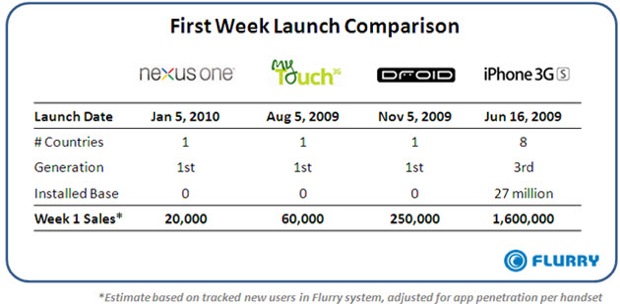
Fast Company just published some great data from Flurry (Mobile Analytics) that significantly questions that success of Google's Nexus One launch. While admittedly, it has only been one week since Google's self-proclaimed "super-phone" came to the market, there is no doubt that it has been a very hard week for Google. The combination of questionable go-to-market strategies (more here), terrible customer experience, and a so-so device (more here) has resulted in a very small success rate in selling this device to the market.


I know that Google is new to the mobile business, but I have to think that many of these problems have been self-inflicted. As I have noted many times, the Googleplex is full of very, very smart people, but the fact is, the mobile phone business is not measured by smart people...but by basic block-and-tackle execution and relentless focus on customer service.  Whether the folks at Google forgot those facts, didn't listen to others, or simply thought that their model for bringing products to market was superior is irrelevant (though not necessarily surprising), the facts speak for themselves. The launch of the Nexus One has been a disaster, and it may be getting worse. And more critically, if Google doesn't get these issues under control ASAP, not only will they likely submarine their whole hardware strategy for the future, but potentially damage their brand in a way that has far more significant implications for the future.

Is that too harsh? If you think so, let me know below:


Wednesday, December 30, 2009

Is Google About to go Mobile? Tuesday, January 5, 2010 Looks Like the Big Day

Interesting rumors swirling around the Googleplex today with the belief that Tuesday, January 5, 2010 is the day that Google goes mobile with the launch of the Nexus One. As expected, details are scarce, but what is known is that Google has scheduled a press conference at its Mountain View, CA headquarters...a mere two days before the largest consumer extravaganza in Las Vegas...the Consumer Electronics Show (CES). Sure, this press conference could also be announcing some new acquisition or addition to their search business, but if you believe that, I have a bridge to sell you..

So, what's the big deal about the Nexus One? Well, on this one I think the jury is still out. Right now, the belief is that Google will have built in the Nexus One a great device and software experience. What that means is TBD, but it almost assuredly means a GSM phone (aka, doesn't work on Verizon or Sprint...but will work globally), a high quality camera, and the Android operating experience. Beyond that, unless you are a Google employee, the best summary of details is probably here.

What will be new however, is that the phone is being sold as "unlocked"...which means it will (in theory), work on any carrier's network. In the US, however, this means the Nexus One will work on T-Mobile and AT&T...but more importantly, will be under the full control of the person who buys it. Additionally, this means that the device will likely be sold at "full cost" and not subsidized by any carrier. But that also means no contracts or commitments by those who buy one.

While this model is standard around the world, it will be interesting to see how it takes off in the US. Generally speaking, US consumers have been trained to pay less than $200 for their smart phones. Given that a phone like the Nexus One probably costs between $500 and $600 to make, it is expected that this full cost will be passed on to the buyer. Don't forget, it wasn't until the iPhone dropped into the $200 range before it really took off. Finally, there is a real possibility that Google will make enemies of the carriers that it relies on for future mobile ads and acceptance of the Android operating system. Google is certainly taking a chance with their go-to-market plans...

Any way you cut it however, the world of mobile in 2010 is off to heckuva start. If 2009 was defined by the launch of the Palm Pre by Sprint and Verizon's Droid (as well as, AT&Ts challenges with the iPhone), 2010 is shaping up to be a barnburner of a year for mobile. Not only will we start off with the launch of the Nexus One, but in late January Apple is expected to launch the (iSlate), and throughout 2010 there will be numerous 4G launches with Clearwire going fully national and LTE coming into the market. Throw in the possibility that the iPhone will move from AT&T or at least to multiple providers and things will certainly be interesting.

LINK: Google Nexus phone to debut Tuesday?

Tuesday, December 29, 2009

The iSlate Cometh. Rumormill on Apple's Tablet Computer Starts to Really Heat Up.

Let the blogosphere ignite! While 2009 ended fairly quietly for Apple, 2010 is sure to begin with tremendous excitement for the much-rumored tablet-based computer from Apple. No one except the good folks in Cupertino really know the truth, but every one seems to have an opinion, idea, thought or just plain gossip to share.

So...what do we think we know? Well, the LA Times and MacRumors.Com have done some serious sleuthing to try and piece things together. What we "know" is that the name of this device is the "iSlate" and that it is expected to be a combination computer, book reader, iPod, Internet device in the form of a traditional tablet-style computer. Also, we know that Apple has reserved the Yerba Buena Center for the Arts in San Francisco in late January (presumably for the announcement, but could also be for a big team meeting). Finally, we know that Apple's stock is going through the roof. For better or worse, the folks on Wall Street usually know something the rest of us don't when it comes to money issues. Beyond that...it is anyones guess.

So, what does the launch of a tablet-computer mean to the market? Well, potentially nothing at all. Not to be a downer, but tablet PCs have been around for a while with only limited success among general consumers. Throw in the likelihood that an Apple machine will cost ~$1000 and this device may only amount to a few percentage points in market share for Apple. Great to see, but far from the iconic device that the iPod has become (billions and billions served) and the popular iPhone.

Of course, the opposite could also be true. Just as the Netbook market was created from virtually nothing to a major portion of the market, the iSlate could also become another iconic device. This is not as far-fetched as it sounds given that Netbooks are already under pressure from "tweener" devices (e.g. more computing power, but low cost) as well as, devices like the Amazon Kindle (perhaps the first fully accepted "tablet" computer...if only for books).

One thing I do know is that whatever Apple does, we will all benefit. Regardless of what you think of the success of Apple's iPhone, iTunes, or the iPod, one indisputable fact is that they each changed consumer expectations and experience for the better by showing the market what could be done when solid design work combined with great execution and vision. While not everything Apple does wins, they can still move the market in incredible ways through their design and delivery. It is always possible that Apple could still strike out, but even a solid double will go a long way here.

Thoughts?

Tuesday, December 22, 2009

How to transfer iTunes music from an old to a new computer

Wanted to share a recent post I made on eHow in preparation for Christmas. As many folks are about to get a new computer to go with their new magic device from Apple, it seemed appropriate to answer the question on how to transfer music from one computer to another.

This step-by-step process should help things make sense of that process. And don't worry...it is pretty easy to do.

Raportt

LINK: How to Transfer iTunes to a New Computer

In the end...there can be only one... Apple seeks to cancel Cable TV

Interesting article in yesterday's Wall Street Journal purporting that CBS and Disney may join with Apple to stream video and television directly to consumer's homes. In a typically Apple-like move, they are providing a pretty nice carrot (e.g. they are offering more money) in the hopes that these content providers are willing to operate inside the closed garden of Apple.

Questions remain though. Among them...

1) Will anyone really buy Apple TV instead of Cable? Sure it is cheaper ($30 vs. $70 typically charged by cable companies), but is that enough? In some ways, this is an extension of the cut-the-cord argument we are seeing as subscribers move from traditional local phones to wireless-only...but the parallels can only be taken so far. Sure, Apple has 100 Million iTunes subscribers (me included)...but that doesnt mean anyone will pay an extra $30 / month for Apple TV. Honestly, I am not sure about this one.

2) Will it really work? One thing Apple has been really good at is rock-solid user experience. A lot of that has been anchored in near total control around user experience, delivery, applications and devices. When it comes to video delivery however, Apple really only owns the end-points (device in your house and server housing the content) with someone else handling the cables in between. Time will tell if that experience is up-to-snuff...or if Apple TV will be doomed by the people in the middle.

3) What about other video options? The internet (Youtube, Hulu, NBC.com) is full of lots of free TV / video content options that will serve to undercut the reasons to buy from Apple. In fact, the only way to ensure people pay more is to cut off options elsewhere. Honestly though, that is going to be tough for folks to swallow. And by folks, I mean everyone...you, me, governement, advertisors, etc.

4) Wait a minute...what if my Internet comes from Cable too? File this one under the "explain it one more time" argument. The best card the cable companies have is that they already control many of the Internet pipes into a person's home. That is of tremendous advantage for any war based on price...and where the playing field has been leveled. Don't get me wrong, Cable TV can be beaten (see Internet, FIOS), but it requires a superior experience to do it. Can Apple pull that off?

For more information, here is the original link. Appreciate any thoughts you may have.

LINK: Apple Seeks to Knock-out Cable TV
 
ss_blog_claim=303abcdf391a89d845773003963de493 ss_blog_claim=303abcdf391a89d845773003963de493