Showing posts with label Google. Show all posts

Monday, October 18, 2010

Circular Rainbow (with plane inside)


So...here is my once-in-a-lifetime event. My wife and I were flying to Miami a little while ago and happened to look out the window to see this amazing circular rainbow. Now, I know "all" rainbows are in fact circular, but given that 99% of us see them from the ground, it almost never looks that way.

Then it didn't end there. While we were mesmerized by the rainbow itself, as we watched, things got even more amazing when we noticed the shadow of our plane *inside* the rainbow.

Absolutely amazing. Has anyone ever seen this phenomenon?

Full disclosure...other than adding a little contrast via Picassa, I have made no changes to these photos. And if you want to know more about circular rainbows...check out this link: http://www.wonderquest.com/rainbow-circle.htm


Tuesday, March 23, 2010

Waiting for the Nexus Two. The Nexus One Has Been Another Misstep by Google


A couple of weeks ago I wrote some blog posts expressing how I felt Google had failed with the launch of their Nexus One. It wasn't that the Nexus One wasn't a cool cell phone, it was just clear that Google's launch of the Nexus One was filled with so many missteps that it could not possibly succeed. Whether those actions were caused by hubris, inexperience or simple loss of mojo, no one really knows.  But when a couple of weeks later it became apparent that the Nexus One wasn't selling, what we all know is that this little experiment has been a failure.

Now it seems as if those early premonitions are becoming true. In fact, a recent series of articles in Gizmodo highlight just how bad things have gotten. While no one (save Google) knows the real numbers, most projections of Nexus One sales peg the total at less than 150,000 units. Even worse, it seems as if the sales volume is decreasing month over month. In the world of wireless sales, that is a flop.

So what is Google to do? Well, they did solve one problem (T-Mobile as the Carrier) by announcing that basically all US Carriers are getting the Nexus One. That is a good first step given that their distribution model was challenging, at best.

What should they do next? Well, Gizmodo again has some good ideas that can be summed as BCS...Better marketing, Customer care improvement and Sell the Nexus One in stores. In short, if Google wants to be considered as a wireless carrier by bringing the Nexus One to market...they need to start acting like one. If not, then all those other blogs I wrote expressing how Google has lost its way will turn out to be true here too.

Monday, February 15, 2010

Why Google Wants to be Your Home Broadband ISP


Google plans to test out gigabit broadband in select markets.


Based on the recent announcements coming out of Mountain View, one might think that the folks at Google are in a race with Proctor and Gamble to launch new products. In one six-month period, Google has entered more new markets than it probably has entered in the last 5 years. First it was being a mobile provider (Nexus One), then becoming a TV advertiser (Google.com / Super Bowl Ads), then their entry into Social Media (Google Buzz), and now, they want to be an Internet Service Provider (ISP).

So what does this latest announcement mean? Well, there is certainly an element of publicity, but I do think they are making these moves to try and ensure a stake in the larger question of where the Internet is going and (hopefully for them), drive other carriers to improve their infrastructure / speeds. Given whom they are partnering with, and the relatively small number of potential end-users, they will not make a big dent in this space…at least on a nationwide basis (For comparison, Comcast alone has ~13M broadband subscribers), but that isn't why Google is making this move. In fact, I would postulate that they can disproprotionately influence the market simply by showing what is possible (1G speed! HD Video! Etc.) and use those successes in public discussions around Net Neutrality, etc. In this way, they hope to improve the US Internet as a whole…and by extension, the services that they can provide to Google-users everywhere.

So what are the top 5 reasons for Google becomming an ISP? Here are mine.

1) Google has lots of money, so why not experiment: This effort may costs billions, and will likely be heavily subsidized, but it won't be free (Google defines it as "competitively priced") and even so, Google has the money to burn. In fact, one of the truisms of technology is that there is only so much that can be done in a lab. Now, if that "lab" has 50,000 - 500,000 users, actively using the Internet / applications / technologies, well, you can certainly learn a lot. To a certain extent, you will only create a Disney World-like environment, but that is certainly a valuable way to learn.

2) Google doesn't want to be your ISP, they want your ISP to be better: As PCWorld correctly stated, the goal of Google is not to become the underlying broadband provider for the US, but to show what is possible from an Internet delivery standpoint.  The fact is, even if they had 500,000 customers (high end) for this experiment, they would barely be in the Top 10 of ISPs in the US. So...what is their goal? Well, I believe a main driver for this activity is that they want to "show" the world (and the FCC) how backwards the US broadband market it and try and drive its improvement. And if they succeed, Google is betting that any improvement to the Internet (especially in speed and quality) will ultimately benefit them by allowing for more and better uses of the Internet (that Google believes it will lead).

3) Don't be Evil is just a Guideline, not a rule (at least when it comes to making money): Back in September 2009, a small but very important change occurred in Google's traditional DbE rule. Specifically, on the corporate web site, Larry Page posted a document entitled Ten things we know to be true that outlined Google's official philosophy on a number of core assumptions and ideas. Most were the same as we know, but # 6 was the most interesting. Specifically, it stated "You can make money without doing evil" and then went on to outline how (shock!) Google, is a business...and like any business is out there to make money. Google Broadband (and the Nexus One, and Google Buzz, etc.) are examples of that.

4) Influence the Net Neutrality debate: Google has been one of the strongest proponents of Net Neutrality, but time will tell how successful they are on this issue. Fact is, Net Neutrality is has a lot of detractors...and those detractors are among the largest companies in the US. At best, Google may get only some broad principles approved and not real change. One way to change that trajectory? Become an ISP and show the FCC how other ISPs are BS-ing the establishment. After all, if Google can show it is possible to consistently deliver 1 Gbps of capacity to the home...why can't Comcast offer 50 Mbps? Or 100 Mbps?

5) Learn what it means to have actual customers: I don't mean to say this lightly, but Google's greatest weakness is that they don't have many customers of their own. Sure, they have millions and millions of users (me being one of them), but they don't really have many that fit the legal definition of a customer (that is: "some one who pays for goods or services"). In fact, the only real customers they have are those that pay for Google Aps or Advertisers who use AdWords to push ads to folks like you or me. In theory, this means that at any point, an individual could stop using Google and only Google would suffer. One of the great learnings that could come out of this exercise is how to directly engage with their customers, provide good customer service, and also, generate new services that are then available elsewhere. To-date, they have not done well here (see: One, Nexus)

Tuesday, February 9, 2010

Has Google Lost its Mojo? Google Buzz is Another Misstep by Google

class=cnet-image
The last few months have been very strange for Google. For an organization that has been admired by many for their success in execution and product development, they seemed to have well, slipped a bit. Sure, they have continued to be embarrassingly profitable, and if anything, their advertising business has been growing and growing, but what about the rest of their business? Well, those efforts have not been nearly as successful.

In fact, if it was any other company that had made these misteps, the blogosphere would be all over them (not to mention, Wall Street). So what have those misteps been? Well, first there was the launch of Google Wave: (which sure sounded cool, but alas was not), then the very blah launch of the Nexus One, and then the whole "China is spying on me" episode, followed by the realization that in wireless, customer care is critical and now, we have the announcement of Google Buzz.

What is Google Buzz? Well, according to Google, it is what social media is supposed to be...at least from Google's perspective. What does it do? Well, some neat things like sharing photos with friends, interfacing with Twitter, etc., but I gotta admit, I don't see this as particularly earth-shattering. Still, you can decide for yourself by watching the video below.


So, what is going on? I can't quite put my finger on it, but it seems like Google has well, forgotten what made them Google. In fact, even their competitors seem to sense that based on the latest responses to Google Buzz. For me, as an outsider, it is hard to say why this is the case, but my two cents is that Google is falling prey to two mistakes. 

The first, is the classic big-company problem of thinking they are smarter than everyone else. Don't get me wrong, Google is very smart (and has lots and lots of smart employees), but that doesn't mean they are infallible. More importantly, for these new lines of business, the details really matter and just being smarter than everyone else doesn't mean you have a good product.

Second, I think there is a real challenge among the vision of the Google leadership team. Schmidt, Brin and Page are deservingly gods in the search and ad space, but they have limited / no experience in wireless, customer care (until today, anyone ever tried to call Google?) and even collaboration / social media. Already, a lot of writers are declaring that Buzz is "boring"...and worse, out-of-touch with what customers want.  Personally, I agree. And in fact, I am much more excited about the recent update in Google Aps that allows you to share files!

So are the wheels falling off in the Googleplex? Of course not...but they still need to stop and rethink some of these recent efforts and new business areas. In business, past success does not beget future success and the recent track record has been pretty ugly.

Monday, January 25, 2010

Seven Reasons Why Google Should Stay in China

 vs. 


There has been a lot of discussion recently regarding Google and its future strategies in China. The genesis for this debate was the recent admission by Google that its systems were recently hacked in an attempt to gain access to the gmail accounts of certain Chinese human rights activists and the possible theft of intellectual property. In response, Google has stated that they will no longer censor their Google.cn website. For those that are unaware, Google.cn is the local Chinese-language site of Google and is generally regarded as the second most popular search site in China behind Baidu.


While I appreciate the moral debate associated with Google's actions, I disagree with their decision to possibly leave China or change their policies regarding search censorship. I do not make this decision lightly, and I certainly understand why many will disagree, but I also firmly believe that Google's decision is short-sighted (at best) and possibly counter-productive (at worst).  


I have outlined below the seven reasons (in no particular order) why I believe that Google should stay in China below. As always, I appreciate my readers opinions and comments.


Seven Reasons Why Google should stay in China


# 1: "Don't Be Evil" is Not A Business Model (aka Your Shareholders Have Expectations Too): Last I checked, Google was a publicly traded, for-profit, shareholder owned corporation. While Google makes great products, and is generally beloved by its users, and has become an inconic brand, Google's purpose in life is to make money for its shareholders...not spread goodness and cheer around the world. Leaving what will soon be the world's largest Internet-user market because of a new-found sense of morality is not a reason for such a radical shift to business strategy. If I was a share holder, I would be asking big questions as to why such a well-known policy matter (search censorship in China) suddenly over road a major international business plan.


#2: Google Knew the Rules When They First Went to China: Nothing has changed since Google first entered China in 2006. For a world-wide phenomenon, I find it hard to believe that Google thought that the Chinese would treat them differently.  And if they did, that is perhaps the most naive thing I have ever heard.


For that matter Google, please stop couching the implementation of bad security policies and practices in your China operations as the excuse that is "driving" you out of China. Allowing penetration of your systems is a failure of security. The fact that they were under attack should not have been a surprise. Seriously, did you think that the Chinese wouldn't try to spy on you and penetrate your systems? At least 20 other companies were also attacked as part of the same effort. 


In case you were wondering, if you Google "China spying on us" you get 1,870,000 hits.


# 3: Some Open Internet in China is Better than None: If Google wants to do some good in the world, providing even a partially censored Internet in China is a very good thing. The fact that the Internet in China is heavily fire walled and restricted is no surprise to anyone. The fact that China market-leader Baidu willingly restricts Internet search to remove terms such as Falun Gong is equally not surprising. That being said, the Internet is a big place and there are still millions of web pages that remain accessible to the average Chinese citizen only via Google. Even censored, Google.cn still provides a great service to the average citizens in China...and that fact alone says Google.cn should stay in operation. 


(Note: For more information on how the Internet in China is censored, check out this Wikipedia page.)


# 4: Google, You Made Your Point Already (In Fact, Maybe Too Much of One) The press around Google leaving China has certainly been global, but now it is time to ratchet it back. While the Western World gets the moral issues associated with this topic, further embarrassing the Chinese leadership on this topic is counter-productive. In fact, the implications of continuing to push the way you have may be more damaging in the long run to a broad swath of companies and industries that want to operate in China.


Now is the time to back off a little bit and come to a resolution that makes sense for both parties. In fact, you might even be able to get some agreement with the government that allows for you to maintain your Do-No-Evil position with the Chinese Government's interests.


#5: You Don't Get to Score if You Don't Play in the Game: Pardon the bad metaphor, but simply put, if Google is not in China, then Google doesn't get to discuss Chinese censorship and policies. We all know that Google is a very influential player in the Internet (in addition to search, advertising, etc.), but that influence is based on participation and market share. One thing that is very true about operating in China is that public officials are sensitive to world opinion and the "face" that China portrays to its neighbors, friends, enemies, and competitors. 


Why cede the position of influence from the largest Internet market in the world? Sure, if Google leaves they will be applauded for their moral position by various members of the blogosphere, but they will also instantly become a non-player regarding Internet policy matters in this part of the world.  Doubt me? How influential is Yahoo on this matter? Not a whole lot given that they left China years ago.


# 6: Where Does it End?: Let's be honest...every nation on Earth has its own interest, policies, and approaches to the Internet and accessibility. While nations like North Korea, Sudan, Iran, and Saudi Arabia are particularly restrictive, even here in the US, our government has acted to restrict Internet access, content, etc. If Google leaves China for a difference in moral opinion, why should it stay in so many other nations? In fact, if I am a country that has a restrictive Internet policy, I now know how to push Google around. Simply require them to restrict a few search items and then dare them to complain. What kind of items? Could be anything? And if Google doesn't like it, they can leave.


# 7: Search is Not, and Never Has Been, A Moral Issue: Google, stop wrapping the issue of search into terms usually associated with conflicts between Good vs. Evil. Search is a tool, only as good as the algorithm that supports it and the results that it provides. We all live most our lives quite well without using search to make our decisions. I don't need Google to know right from wrong, much less to know that it is wrong to steal. Associating the Chinese Government's restrictions on search at the same level as the challenges of living under an autocratic regime is ludicrous. 


And besides, what is the difference between not making a search result available (as in China) vs. only making a result available on page 300 of the search results? What's the difference among having a company pay for a search result to appear high on a list vs. never showing it at all? For that matter, who decides what exactly is click-fraud? Or even how does the Google search algorithm work and how does it prioritize results? I know there is a lot of grey in these questions, but there is no such thing as search purity and philosophically, I doubt the Chinese see much of a difference.


In China, we call manipulating search results to be censorship. In the US, we call it advertising. The fact it is, both are manipulations of a given set of data to serve a specific purpose.  Search, of all things, is not an either / or issue, so why are we trying to make search to be such a thing?  


Full Disclosure Statement: This blog was originally written on Google Docs and has been posted using a Google-owned Blogging tool that contains Google-supplied Ads.

Thursday, January 14, 2010

Want a Nexus One? Shouldn't be a problem...but caveat emptor.


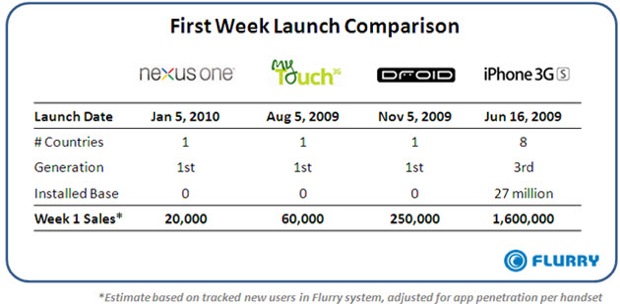
Fast Company just published some great data from Flurry (Mobile Analytics) that significantly questions that success of Google's Nexus One launch. While admittedly, it has only been one week since Google's self-proclaimed "super-phone" came to the market, there is no doubt that it has been a very hard week for Google. The combination of questionable go-to-market strategies (more here), terrible customer experience, and a so-so device (more here) has resulted in a very small success rate in selling this device to the market.


I know that Google is new to the mobile business, but I have to think that many of these problems have been self-inflicted. As I have noted many times, the Googleplex is full of very, very smart people, but the fact is, the mobile phone business is not measured by smart people...but by basic block-and-tackle execution and relentless focus on customer service.  Whether the folks at Google forgot those facts, didn't listen to others, or simply thought that their model for bringing products to market was superior is irrelevant (though not necessarily surprising), the facts speak for themselves. The launch of the Nexus One has been a disaster, and it may be getting worse. And more critically, if Google doesn't get these issues under control ASAP, not only will they likely submarine their whole hardware strategy for the future, but potentially damage their brand in a way that has far more significant implications for the future.

Is that too harsh? If you think so, let me know below:


Tuesday, January 12, 2010

Give me Net Neutrality, Or Give Me Death - January 12, 2010

Interesting article this past week published in the National Journal describing how the debate around Net Neutrality has escalated into a "free speech" debate with each side citing 1st Amendment grounds as to why Net Neutrality (NetNet) rules should or should not be enacted. In particular, while one side is citing NetNet as required to *protect* 1st Amendment speech of individual users...the other side is saying that implementing this rule could in fact, infringe upon the free speech of content providers, ISPs, and portals. As summed up by National Cable & Telecommunications Association President Kyle McSlarrow:

Strict new FCC regulations might infringe on the ability of content providers to speak "how" they wish by preventing them from paying for better service; might prevent innovations by ISPs that would better facilitate free speech; could amount to "forced" speech; and might impact the delivery of high-bandwidth services such as video programming by laying a path toward government regulation of bandwidth use.
For the uninitiated, NetNet is a proposal by the US Federal Communications Commission (FCC) that seeks to add certain principles to the regulation of US Internet Service Providers (ISPs) ensuring that all traffic sent over an ISPs "pipes" be treated equally. In effect, it would stop an ISP from stopping or preferring one type of traffic (e.g. Voice over IP) except in very specific circumstances.

On one side of the debate, proponents of the FCC's proposed NetNet rules believe they are necessary in order to preserve the free speech of individuals and keep ISPs from regulating, controlling, or preferring certain content over other content. In effect, this side believes that institutionalizing the open Internet is a cornerstone for the future success of the global network. It should be noted that the biggest proponents of NetNet are the large application and portal providers (e.g. Google, Yahoo, etc.) who say they are acting on behalf of the consumer. That is probably true, however, these are also multi-billion dollar companies with significant revenue and profit at stake.

On the other side of the debate, opponents of NetNet believe that the current Internet model works fine, and that the imposition of these proposed new rules is not only unnecessary, but also will restrict the future growth and development of the Internet. On the first point...they are probably right (the Internet works pretty well), though on the second, that is debatable. It should also be noted that the opponents of NetNet are the large Internet Carriers (who provide the backbone for the Internet), Cable Companies, and the large phone companies (e.g. Verizon, AT&T). Again, all companies with multi-billions of dollars at stake.

As for whether or not NetNet is a 1st Amendment argument, no one really knows. Critical to this question is whether or not a company even has 1st Amendment rights (or if these are only vested in individuals). Also, there are a lot of old court cases that seem to argue both sides of this question. None the less, it is clear that NetNet issues are going to be a source of major debate in 2010 and a topic of significant interest and debate.

LINK: National Journal: Net Neutrality Fight Turns To First Amendment

LINK: Wikipedia: Net Neutrality

Saturday, January 9, 2010

Google Plays the Ad Game: The Most Remarkable Thing About the Launch of the Nexus One is not the Phone


An earth-shattering thing occurred this week with Google...and it wasn't just the launch of their mobile phone the Nexus One. Yes, that was interesting (more about that HERE), but it was the *way* in which Google brought this phone to market. While a lot of folks focused on the device's characteristics, or that it is unlocked, that is not what surprised me.

So...what did I think was remarkable? Well...

1) Google advertised the Nexus One on www.Google.com: While it sounds obvious to do this (after all, most companies do), this is a big change for Google. To-date, they have avoided selling any of their own products directly off of Google.com (e.g. Android, Adsense, Aps, etc.). Suddenly, the Nexus One appears on their home page directly promoting and enabling the sale of the device (And that doesn't even count what Google is doing as part of their own ad distribution network). That is not a minor change for the Googleplex.

2) Google is fulfilling the Nexus One directly: When was the last time you ever bought anything directly from Google and had it delivered to your home? Sure, you may have used Google to find something...and then bought from another vendor's site, but Google directly? And on those occasions where you paid Google (e.g. Google Aps), it isn't like something arrived in your mailbox. It is pretty remarkable that Google has built an infrastructure to deliver products. It will be interesting to see how good they are at this (and in fact, there are already complaints. See HERE).

3) Google is now competing against some of its best partners: For better or worse, Google has been very careful to avoid competing against its biggest mobile partners. To-date, they have stuck to selling Android as an operating system and striking search deals on mobile phones and websites. Sprint, Verizon and others sell a huge amount of Android-based cell phones which Google gets a share of. Now, they are basically introducing an entire line of products (e.g. it won't stop with the Nexus One) that could take share from their best friends.

So what is the impact of this change for the future? Well, time will tell. But among the questions I want to see answered are:

1) What is the future of Android? It used to be just about software on a mobile phone. Is that still the case? Or will Google build a whole line of its own devices that compete against the Android operating system.

2) What is the future of partnerships with mobile carriers like Verizon and Sprint? These two carriers represent fully 50% of the mobile phone business in the US. For the short term, I am sure nothing will change, but neither will look kindly on Google if they start to lose share to a directly sold Google phone.

3) Is Google about to "Yahoo" their website? One of the keys to Google's success has been their carefully constructed persona and strategy. Among that has been the simplicity of their website and the perception that they are not playing favorites (perception...because, of course they do play favorites). Will that still be the case?

4) Will they still be proponents of Net Neutrality? Google has been one of the biggest proponents of the FCC's proposed Net Neutrality legislation. Publicly, this is because they profess support for an "open" Internet...but like any large, for-profit company, also because the proposed legislation benefits them. It will be interesting to see if this proposal still holds. After all, now that they are in the hardware business, things are different. For instance, can someone use the Nexus One and make Bing (from Microsoft) the default search tool? What about other applications? Time will tell.

Tuesday, January 5, 2010

Google...I am Officially Underwhelmed. Why the Nexus One is Not Iconic

So it was with much fan fair that Google announced the Nexus One today. After years and years of speculation, Google ended its position as a "simple software" company (or more accurately, an advertising company that uses software) to become a hardware company producing (along with HTC) its own wireless device.  Needless to say, there was much rejoicing in the blogosphere with rumors, write ups from Endgaget Endgaget and Wired (and even my own HERE), and postulations everywhere. 

So...what do we think of their first foray? Well...before we discuss that, lets focus on what we learned today.

What we now know and like:

1) It's Pretty: The Nexus One looks a whole lot like what every "iconic" device since the iPhone was launched. It is small, sleek, curvy and black. 
2) It's Android: This one was obvious. Google has apparently built its own version of its Android software to power this phone, but it is still Android. While Android isn't as popular as many other mobile OSs, it is still damn good and worthy of being the OS for this device.
3) It's got an awesome camera: Honestly, I still think that except for voice (and triaging email), the camera is the next most useful capability for a smartphone. At 5 megapixels and a flash, this camera really a legitimate replacement for anything but an SLR.
4) It's unlocked: More on the negatives of this later...but there is something to say about being able to buy this device contract and commitment free. This is the model for most of the rest of the world and I see no issues with this being an option in the US too. Of course, I am not sure how practical the benefits are.
5) You can buy it off the web: Getting one is as simple as going to www.google.com/phone and buy the Nexus One yourself. Admittedly, ecommerce is not magic...but given that I have never bought anything from Google you can touch, I have to give them props for trying this approach. Needless to say though, it will be a little interesting to watch what happens when there is problem with the mail.

What we now know and DONT Like:

1) The tag "Superphone:" First...just because you say something is "super" doesn't mean it is. Second...I am not sure the Nexus One is that much better than other Android-based devices already in the market from Sprint, Verizon or T-Mobile.
2) It's on T-Mobile: Umm...seriously? I mean, yes, they had the first Android phone...but if you want to launch an iconic device with incredible data / Internet capabilities, T-Mobile is not that carrier.
3) It's expensive: In Europe and Asia, buying a phone at full cost is considered normal. Unfortunately, that is not the case in the US. Here, even the smartest of smart phones are expected to cost no more than $250. It is great that Google has made the phone unlocked, but at $530 ($179 on a T-Mob plan) that benefit comes with a steep cost. Honestly, it strikes me as hubris (or naivety) that Google went down this path.
4) It doesn't allow tethering: WTF?!? If only to upstage the iPhone, this functionality should be in day one. Tethering is a key feature that many folks expect (especially the "prosumer" types who buy smartphones). To not have it speaks to unnecessary restrictions. And then no multi-touch either?!? Oh man...
5) It doesn't sync with exchange: Seriously? We all know Microsoft is the root-of-all evil, but Microsoft is still a necessary evil. Please tell me I am wrong on this one.
6) It is not iconic: Given the wait, hype, and emotion surrounding this launch I frankly, expected more. Not that the Nexus One doesn't seem to be a good device (maybe even great)...but it is not that different than Android phones that were available yesterday (pre-Nexus One). 

What we have concluded:

The one thing that I see the Nexus One as being a game changer is the fact that Google is now in the mobile hardware business. After all, even Microsoft, with its Windows Mobile / Phone and eponymous software never strayed into this line of business (maybe that now changes?). The fact that Google has decided to do so is a big deal...and one that will have long term implications to its other channels and partners...and potentially the very future of Android. I am sure that the folks at the Googleplex thought long and hard over this issue, but this change is momentous. 

As I noted in this title however, I am still underwhelmed with the Nexus One. Yes, it seems to be a cool new device, but that is about it. The hubbub around its launch was misplaced, as were the expectations. Whether this was because Google was so hands on in its design, or the US wireless market so restrictive, or HTC was holding back, I don't know, but in the end, what we got today was probably not well-aligned with the pre-launch expectations. 

Wednesday, December 30, 2009

Is Google About to go Mobile? Tuesday, January 5, 2010 Looks Like the Big Day

Interesting rumors swirling around the Googleplex today with the belief that Tuesday, January 5, 2010 is the day that Google goes mobile with the launch of the Nexus One. As expected, details are scarce, but what is known is that Google has scheduled a press conference at its Mountain View, CA headquarters...a mere two days before the largest consumer extravaganza in Las Vegas...the Consumer Electronics Show (CES). Sure, this press conference could also be announcing some new acquisition or addition to their search business, but if you believe that, I have a bridge to sell you..

So, what's the big deal about the Nexus One? Well, on this one I think the jury is still out. Right now, the belief is that Google will have built in the Nexus One a great device and software experience. What that means is TBD, but it almost assuredly means a GSM phone (aka, doesn't work on Verizon or Sprint...but will work globally), a high quality camera, and the Android operating experience. Beyond that, unless you are a Google employee, the best summary of details is probably here.

What will be new however, is that the phone is being sold as "unlocked"...which means it will (in theory), work on any carrier's network. In the US, however, this means the Nexus One will work on T-Mobile and AT&T...but more importantly, will be under the full control of the person who buys it. Additionally, this means that the device will likely be sold at "full cost" and not subsidized by any carrier. But that also means no contracts or commitments by those who buy one.

While this model is standard around the world, it will be interesting to see how it takes off in the US. Generally speaking, US consumers have been trained to pay less than $200 for their smart phones. Given that a phone like the Nexus One probably costs between $500 and $600 to make, it is expected that this full cost will be passed on to the buyer. Don't forget, it wasn't until the iPhone dropped into the $200 range before it really took off. Finally, there is a real possibility that Google will make enemies of the carriers that it relies on for future mobile ads and acceptance of the Android operating system. Google is certainly taking a chance with their go-to-market plans...

Any way you cut it however, the world of mobile in 2010 is off to heckuva start. If 2009 was defined by the launch of the Palm Pre by Sprint and Verizon's Droid (as well as, AT&Ts challenges with the iPhone), 2010 is shaping up to be a barnburner of a year for mobile. Not only will we start off with the launch of the Nexus One, but in late January Apple is expected to launch the (iSlate), and throughout 2010 there will be numerous 4G launches with Clearwire going fully national and LTE coming into the market. Throw in the possibility that the iPhone will move from AT&T or at least to multiple providers and things will certainly be interesting.

LINK: Google Nexus phone to debut Tuesday?
 
ss_blog_claim=303abcdf391a89d845773003963de493 ss_blog_claim=303abcdf391a89d845773003963de493