Showing posts with label Nexus One. Show all posts

Saturday, April 3, 2010

D-Day Arrives. Will the iPad Win the Day or be Pushed Back into the Sea?


(Thanks to TechChunks for their great pic)
Amazing! Incredible! 
Laptop Killer! Absurd! A giant iPod Touch! A waste of money. Which of these terms defines the iPad to you? Or do you have a definition of your own?
One of the most amazing things about the arrival of the iPad's arrival is how *everyone* seems to have an opinion about it. Ever since it was first announced, the blogosphere has been a flutter about whether or not the iPad would be as "amazing" as Steve Jobs said it would be and create an entirely new market segment for consumer tech (see video at bottom). Or, would it fall short of its goals and become another interesting, albeit small part of the Apple product portfolio.

With the imminent arrival of the iPad to users around the US, David Pogue of the New York Times gets into the game by professing its well...its own indecision by writing not one, but two reviews of the iPad. The first, a "review for Techies" basically sums up the iPad as "basically a gigantic iPod Touch." While Mr. Pogue says a lot of positive things, he also makes clear his "techie" feelings in the following quote.
The bottom line is that you can get a laptop for much less money — with a full keyboard, DVD drive, U.S.B. jacks, camera-card slot, camera, the works. Besides: If you’ve already got a laptop and a smartphone, who’s going to carry around a third machine?
The second review "for everyone else" is far more kind. As Mr. Pogue also notes, in some cases, bigger really is better...especially when bigger means supporting maps, books and movies much, much better than any other Apple device to-date. Also, he gives fair credit to some of Apple's attempts at pricing and contracts for 3G wireless that are admirable. Equally important, Mr. Pogue notes that the "The iPad’s killer app, though, is killer apps." And on that, I don't think there is any doubt.
Still, put succinctly, the review can be summed up in one sentence. "The haters tend to be techies; the fans tend to be regular people." 

So what are you?

For me, well, I am firmly in the techie category. While I love the idea of the iPad, I hate what came out...at least in version 1.0. The device is unquestionably cool and useful for many things (e.g. music, movies, and Internet), but it is also unquestionably useless for many others (emails, multi-tasking, business applications). It is also very expensive, limited in capabilities, and has a number of feature deficiencies. Does that mean I won't buy one ever? Not at all, but until many of the gaps are fixed from my previous blog on this topic (The iPad Cameth. And...I Am Not Sure It Mattered), it won't be any time soon.

So what do you think? Anyone already have an iPad? And what do you think? Even if you are not sure where you stand, be sure to check-out Steve Colbert's iPad experience below.


Tuesday, March 23, 2010

Waiting for the Nexus Two. The Nexus One Has Been Another Misstep by Google


A couple of weeks ago I wrote some blog posts expressing how I felt Google had failed with the launch of their Nexus One. It wasn't that the Nexus One wasn't a cool cell phone, it was just clear that Google's launch of the Nexus One was filled with so many missteps that it could not possibly succeed. Whether those actions were caused by hubris, inexperience or simple loss of mojo, no one really knows.  But when a couple of weeks later it became apparent that the Nexus One wasn't selling, what we all know is that this little experiment has been a failure.

Now it seems as if those early premonitions are becoming true. In fact, a recent series of articles in Gizmodo highlight just how bad things have gotten. While no one (save Google) knows the real numbers, most projections of Nexus One sales peg the total at less than 150,000 units. Even worse, it seems as if the sales volume is decreasing month over month. In the world of wireless sales, that is a flop.

So what is Google to do? Well, they did solve one problem (T-Mobile as the Carrier) by announcing that basically all US Carriers are getting the Nexus One. That is a good first step given that their distribution model was challenging, at best.

What should they do next? Well, Gizmodo again has some good ideas that can be summed as BCS...Better marketing, Customer care improvement and Sell the Nexus One in stores. In short, if Google wants to be considered as a wireless carrier by bringing the Nexus One to market...they need to start acting like one. If not, then all those other blogs I wrote expressing how Google has lost its way will turn out to be true here too.

Monday, March 1, 2010

Why the iPhone User Experience Really Struggles. Response to Ars Technica's Recent Analysis.


Ars Technica: The Art of Technology VS 

Great article last week from Ars Technica postulating on one of the other major reasons why iPhone users are having problems with their network service and performance. Entitled "How smartphones are bogging down some wireless carriers," Chris Foresman hypothesizes that the real cause of the iPhone problems on the AT&T network can be traced to the way in which the iPhone pulls information in "short bursts" from the AT&T network for texting, web browsing, etc. According to Mr. Foresman's theory, it is this move among active and dormant state...which also helps to preserve battery life...that results in the widely recognized poor user experience that many iPhone users (especially in large cities) complain about.

As for what I think of this article, from a purely theoretical basis, I think it is a fun read. It draws on some interesting tidbits regarding the deployment of the iPhone globally and an interesting engineering-level perspective on how wireless networks operate. It also draws out some nice commentary regarding network design.

From a practical level however, I think that the proposed hypothesis is frankly, bogus. Blaming the atrocious experience that some iPhone users experience in cities like New York and San Francisco with the way in which the iPhone moves among active and dormant communication states on the AT&T network is not grounded in the reality of wireless networking. This opinion is centered on three main facts. 

# 1...If the problem was this simple, it would have been fixed by now: If this network switch was the real cause of poor performance, don't we really think that AT&T or Apple would have made adjustments by now? Especially given the incredible pressure to improve user experience? Fact is, wireless carriers and their device suppliers spend an inordinate amount of time stressing over the balancing act of performance vs. battery life. If the powers-that-be could fix their performance issue with such a relatively simple fix, it seems to me that they would have done that already. Yes, it might impact batter life of the iPhone, but poor battery life is a whole lot better than poor service altogether.

# 2...Why aren't all iPhones (throughout the US) having this problem? By all accounts, the worst iPhone experiences are in the largest US cities like New York and San Francisco. iPhones in Tampa, Washington, D.C., and Poughkeepsie seemingly have no issues. Frankly, if Ars Technica has found the magic iPhone glitch, then one would assume that all iPhones everywhere would have the same bad experience. Since they don't, it must mean that there is some other cause.

# 3...But wait, what about O2's network in the UK? I am no expert in the O2 network, but the fact that their users in the UK (specifically London) are experiencing the worst service speaks most strongly to the fact that this is not an active / dormant state issue. In fact, this seems to prove the idea that there is combination of other impacts that are resulting in bad user experience. In particular, network capacity and management (combined with high numbers of users) resulting in network stress.

So, does that mean the switch among active and dormant state is not an issue at all? In fairness, there is probably some kernel of truth, but I would offer that it is probably one of the smallest impacts related to user experience. More likely, this is a classic case where the writers are making the mistake of concluding that correlation implies causation. Yes, it sounds a bit strange that AT&T and O2 would have similar issues...but it is highly doubtful that the iPhone's switch among active and dormant state would be the reason. 

In fact, the more likely reasons for service problems with the iPhone can be gleaned from where the biggest complaints occur. After all, the common denominator with this problem is not the iPhone...but the use of the iPhone in a large city, with lots of users, challenging spectrum / coverage models, highly centralized user base, limited RF spectrum, and difficult economic considerations impacting network upgrades. These characteristics are all things that New York, San Francisco, and London share...and likely the cause of the poor experience for iPhone owners in these areas.

Monday, February 15, 2010

Why Google Wants to be Your Home Broadband ISP


Google plans to test out gigabit broadband in select markets.


Based on the recent announcements coming out of Mountain View, one might think that the folks at Google are in a race with Proctor and Gamble to launch new products. In one six-month period, Google has entered more new markets than it probably has entered in the last 5 years. First it was being a mobile provider (Nexus One), then becoming a TV advertiser (Google.com / Super Bowl Ads), then their entry into Social Media (Google Buzz), and now, they want to be an Internet Service Provider (ISP).

So what does this latest announcement mean? Well, there is certainly an element of publicity, but I do think they are making these moves to try and ensure a stake in the larger question of where the Internet is going and (hopefully for them), drive other carriers to improve their infrastructure / speeds. Given whom they are partnering with, and the relatively small number of potential end-users, they will not make a big dent in this space…at least on a nationwide basis (For comparison, Comcast alone has ~13M broadband subscribers), but that isn't why Google is making this move. In fact, I would postulate that they can disproprotionately influence the market simply by showing what is possible (1G speed! HD Video! Etc.) and use those successes in public discussions around Net Neutrality, etc. In this way, they hope to improve the US Internet as a whole…and by extension, the services that they can provide to Google-users everywhere.

So what are the top 5 reasons for Google becomming an ISP? Here are mine.

1) Google has lots of money, so why not experiment: This effort may costs billions, and will likely be heavily subsidized, but it won't be free (Google defines it as "competitively priced") and even so, Google has the money to burn. In fact, one of the truisms of technology is that there is only so much that can be done in a lab. Now, if that "lab" has 50,000 - 500,000 users, actively using the Internet / applications / technologies, well, you can certainly learn a lot. To a certain extent, you will only create a Disney World-like environment, but that is certainly a valuable way to learn.

2) Google doesn't want to be your ISP, they want your ISP to be better: As PCWorld correctly stated, the goal of Google is not to become the underlying broadband provider for the US, but to show what is possible from an Internet delivery standpoint.  The fact is, even if they had 500,000 customers (high end) for this experiment, they would barely be in the Top 10 of ISPs in the US. So...what is their goal? Well, I believe a main driver for this activity is that they want to "show" the world (and the FCC) how backwards the US broadband market it and try and drive its improvement. And if they succeed, Google is betting that any improvement to the Internet (especially in speed and quality) will ultimately benefit them by allowing for more and better uses of the Internet (that Google believes it will lead).

3) Don't be Evil is just a Guideline, not a rule (at least when it comes to making money): Back in September 2009, a small but very important change occurred in Google's traditional DbE rule. Specifically, on the corporate web site, Larry Page posted a document entitled Ten things we know to be true that outlined Google's official philosophy on a number of core assumptions and ideas. Most were the same as we know, but # 6 was the most interesting. Specifically, it stated "You can make money without doing evil" and then went on to outline how (shock!) Google, is a business...and like any business is out there to make money. Google Broadband (and the Nexus One, and Google Buzz, etc.) are examples of that.

4) Influence the Net Neutrality debate: Google has been one of the strongest proponents of Net Neutrality, but time will tell how successful they are on this issue. Fact is, Net Neutrality is has a lot of detractors...and those detractors are among the largest companies in the US. At best, Google may get only some broad principles approved and not real change. One way to change that trajectory? Become an ISP and show the FCC how other ISPs are BS-ing the establishment. After all, if Google can show it is possible to consistently deliver 1 Gbps of capacity to the home...why can't Comcast offer 50 Mbps? Or 100 Mbps?

5) Learn what it means to have actual customers: I don't mean to say this lightly, but Google's greatest weakness is that they don't have many customers of their own. Sure, they have millions and millions of users (me being one of them), but they don't really have many that fit the legal definition of a customer (that is: "some one who pays for goods or services"). In fact, the only real customers they have are those that pay for Google Aps or Advertisers who use AdWords to push ads to folks like you or me. In theory, this means that at any point, an individual could stop using Google and only Google would suffer. One of the great learnings that could come out of this exercise is how to directly engage with their customers, provide good customer service, and also, generate new services that are then available elsewhere. To-date, they have not done well here (see: One, Nexus)

Tuesday, February 9, 2010

Has Google Lost its Mojo? Google Buzz is Another Misstep by Google

class=cnet-image
The last few months have been very strange for Google. For an organization that has been admired by many for their success in execution and product development, they seemed to have well, slipped a bit. Sure, they have continued to be embarrassingly profitable, and if anything, their advertising business has been growing and growing, but what about the rest of their business? Well, those efforts have not been nearly as successful.

In fact, if it was any other company that had made these misteps, the blogosphere would be all over them (not to mention, Wall Street). So what have those misteps been? Well, first there was the launch of Google Wave: (which sure sounded cool, but alas was not), then the very blah launch of the Nexus One, and then the whole "China is spying on me" episode, followed by the realization that in wireless, customer care is critical and now, we have the announcement of Google Buzz.

What is Google Buzz? Well, according to Google, it is what social media is supposed to be...at least from Google's perspective. What does it do? Well, some neat things like sharing photos with friends, interfacing with Twitter, etc., but I gotta admit, I don't see this as particularly earth-shattering. Still, you can decide for yourself by watching the video below.


So, what is going on? I can't quite put my finger on it, but it seems like Google has well, forgotten what made them Google. In fact, even their competitors seem to sense that based on the latest responses to Google Buzz. For me, as an outsider, it is hard to say why this is the case, but my two cents is that Google is falling prey to two mistakes. 

The first, is the classic big-company problem of thinking they are smarter than everyone else. Don't get me wrong, Google is very smart (and has lots and lots of smart employees), but that doesn't mean they are infallible. More importantly, for these new lines of business, the details really matter and just being smarter than everyone else doesn't mean you have a good product.

Second, I think there is a real challenge among the vision of the Google leadership team. Schmidt, Brin and Page are deservingly gods in the search and ad space, but they have limited / no experience in wireless, customer care (until today, anyone ever tried to call Google?) and even collaboration / social media. Already, a lot of writers are declaring that Buzz is "boring"...and worse, out-of-touch with what customers want.  Personally, I agree. And in fact, I am much more excited about the recent update in Google Aps that allows you to share files!

So are the wheels falling off in the Googleplex? Of course not...but they still need to stop and rethink some of these recent efforts and new business areas. In business, past success does not beget future success and the recent track record has been pretty ugly.

Thursday, January 14, 2010

Want a Nexus One? Shouldn't be a problem...but caveat emptor.


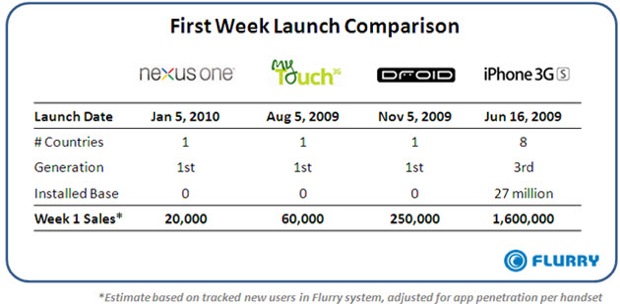
Fast Company just published some great data from Flurry (Mobile Analytics) that significantly questions that success of Google's Nexus One launch. While admittedly, it has only been one week since Google's self-proclaimed "super-phone" came to the market, there is no doubt that it has been a very hard week for Google. The combination of questionable go-to-market strategies (more here), terrible customer experience, and a so-so device (more here) has resulted in a very small success rate in selling this device to the market.


I know that Google is new to the mobile business, but I have to think that many of these problems have been self-inflicted. As I have noted many times, the Googleplex is full of very, very smart people, but the fact is, the mobile phone business is not measured by smart people...but by basic block-and-tackle execution and relentless focus on customer service.  Whether the folks at Google forgot those facts, didn't listen to others, or simply thought that their model for bringing products to market was superior is irrelevant (though not necessarily surprising), the facts speak for themselves. The launch of the Nexus One has been a disaster, and it may be getting worse. And more critically, if Google doesn't get these issues under control ASAP, not only will they likely submarine their whole hardware strategy for the future, but potentially damage their brand in a way that has far more significant implications for the future.

Is that too harsh? If you think so, let me know below:


Tuesday, January 5, 2010

Google...I am Officially Underwhelmed. Why the Nexus One is Not Iconic

So it was with much fan fair that Google announced the Nexus One today. After years and years of speculation, Google ended its position as a "simple software" company (or more accurately, an advertising company that uses software) to become a hardware company producing (along with HTC) its own wireless device.  Needless to say, there was much rejoicing in the blogosphere with rumors, write ups from Endgaget Endgaget and Wired (and even my own HERE), and postulations everywhere. 

So...what do we think of their first foray? Well...before we discuss that, lets focus on what we learned today.

What we now know and like:

1) It's Pretty: The Nexus One looks a whole lot like what every "iconic" device since the iPhone was launched. It is small, sleek, curvy and black. 
2) It's Android: This one was obvious. Google has apparently built its own version of its Android software to power this phone, but it is still Android. While Android isn't as popular as many other mobile OSs, it is still damn good and worthy of being the OS for this device.
3) It's got an awesome camera: Honestly, I still think that except for voice (and triaging email), the camera is the next most useful capability for a smartphone. At 5 megapixels and a flash, this camera really a legitimate replacement for anything but an SLR.
4) It's unlocked: More on the negatives of this later...but there is something to say about being able to buy this device contract and commitment free. This is the model for most of the rest of the world and I see no issues with this being an option in the US too. Of course, I am not sure how practical the benefits are.
5) You can buy it off the web: Getting one is as simple as going to www.google.com/phone and buy the Nexus One yourself. Admittedly, ecommerce is not magic...but given that I have never bought anything from Google you can touch, I have to give them props for trying this approach. Needless to say though, it will be a little interesting to watch what happens when there is problem with the mail.

What we now know and DONT Like:

1) The tag "Superphone:" First...just because you say something is "super" doesn't mean it is. Second...I am not sure the Nexus One is that much better than other Android-based devices already in the market from Sprint, Verizon or T-Mobile.
2) It's on T-Mobile: Umm...seriously? I mean, yes, they had the first Android phone...but if you want to launch an iconic device with incredible data / Internet capabilities, T-Mobile is not that carrier.
3) It's expensive: In Europe and Asia, buying a phone at full cost is considered normal. Unfortunately, that is not the case in the US. Here, even the smartest of smart phones are expected to cost no more than $250. It is great that Google has made the phone unlocked, but at $530 ($179 on a T-Mob plan) that benefit comes with a steep cost. Honestly, it strikes me as hubris (or naivety) that Google went down this path.
4) It doesn't allow tethering: WTF?!? If only to upstage the iPhone, this functionality should be in day one. Tethering is a key feature that many folks expect (especially the "prosumer" types who buy smartphones). To not have it speaks to unnecessary restrictions. And then no multi-touch either?!? Oh man...
5) It doesn't sync with exchange: Seriously? We all know Microsoft is the root-of-all evil, but Microsoft is still a necessary evil. Please tell me I am wrong on this one.
6) It is not iconic: Given the wait, hype, and emotion surrounding this launch I frankly, expected more. Not that the Nexus One doesn't seem to be a good device (maybe even great)...but it is not that different than Android phones that were available yesterday (pre-Nexus One). 

What we have concluded:

The one thing that I see the Nexus One as being a game changer is the fact that Google is now in the mobile hardware business. After all, even Microsoft, with its Windows Mobile / Phone and eponymous software never strayed into this line of business (maybe that now changes?). The fact that Google has decided to do so is a big deal...and one that will have long term implications to its other channels and partners...and potentially the very future of Android. I am sure that the folks at the Googleplex thought long and hard over this issue, but this change is momentous. 

As I noted in this title however, I am still underwhelmed with the Nexus One. Yes, it seems to be a cool new device, but that is about it. The hubbub around its launch was misplaced, as were the expectations. Whether this was because Google was so hands on in its design, or the US wireless market so restrictive, or HTC was holding back, I don't know, but in the end, what we got today was probably not well-aligned with the pre-launch expectations. 
 
ss_blog_claim=303abcdf391a89d845773003963de493 ss_blog_claim=303abcdf391a89d845773003963de493